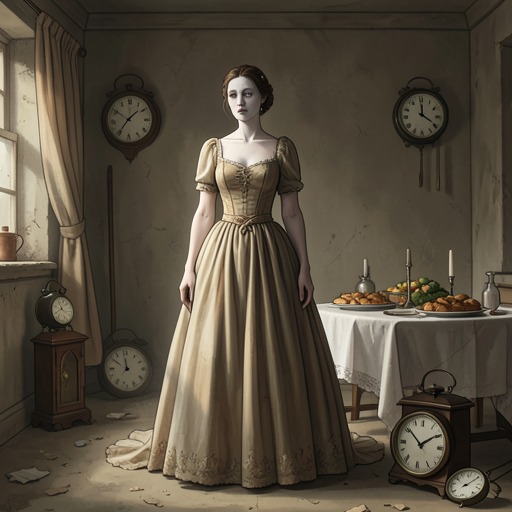
The wedding cake of Ms. Hao Weixiang
Great ExpectationsMiss Havisham’s wedding cake is the ruined bridal cake preserved on the feast table at Satis House, where it turns a wedding relic into a measure of arrested time. Miss Havisham names it as her own and links its decay to hers: the cake and its keeper have worn away together, while its intended place beside her corpse makes the object part of her imagined final scene of vengeance.
Appearance and Place in the House
When Pip first sees the feast chamber, daylight has been shut out and a reluctant fire gives little warmth. The spacious room, once handsome, is coated with dust and mould and visibly falling apart. On its long table lies a cloth spread as if a feast had been about to begin when the house and its clocks stopped together. At the centre, an epergne or other ornament is so buried in cobwebs that its shape can no longer be made out; spiders run over and around it, and mice stir behind the panels.
The cake lies within this tableau of suspended celebration and advancing decay. Pip cannot identify the cobweb-covered object when Miss Havisham points to it. She tells him it is a great cake, her bride-cake. Its scale and former ceremonial purpose survive in her naming of it, but its present appearance has been overtaken by dust, webs, and the life of the creatures that occupy the neglected room. The cake is thus not presented as a serving or a keepsake kept intact: it has become part of the ruined environment.
The Anniversary and Miss Havisham’s Meaning
Miss Havisham says the cake and she were brought there on the same day of the year, long before Pip was born. She forbids people to speak of what happened, although visitors come on that anniversary. Instead, she points at the heap of decay with her crutched stick and describes the cake and herself as having worn away together. The image makes the object a material record of duration: time has not restored the abandoned celebration but has worked upon the wedding relic and the woman who remains beside it.
She imagines the room as the setting for her death as well as for the failed feast. Pointing to the table, she tells Pip that it is where she will be laid when dead, and that people will come there to look at her. She later specifies the intended arrangement: they will lay her dead in her bride’s dress on the bride’s table. She calls this the finished curse upon the man who abandoned her and says it would be better if the ruin were complete on the anniversary itself. The cake’s position on the table therefore connects three moments that the house holds together—the wedding feast that never proceeded as intended, Miss Havisham’s continuing decay, and the death scene she plans as revenge.
Motif of Stoppage and Repeated Return
The cake belongs to a room in which stopped time is made concrete by both objects and architecture. When Pip first enters Miss Havisham’s presence, he notices that her watch and a clock have both stopped at twenty minutes to nine. Later, he enters the feast chamber: its tablecloth suggests a meal halted at the instant the house and its clocks stopped, while the cake’s cobwebs and mould show that the interruption has lasted long enough for living things to claim the abandoned setting. The cake is at once a remnant of a particular day and evidence that the house’s present has been prolonged far beyond it.
The relic also returns as part of Pip’s later visits. When Miss Havisham sends Estella and Pip into the neglected garden, she says that on their return Pip is to wheel her about a little as in former times. The old routine places him again inside the domestic world organized around her preserved past; the feast chamber and its bridal remains are not a single shocking discovery but elements of a pattern into which she repeatedly draws him. On a later night, Pip cannot sleep in the separate building across the courtyard. He sees Miss Havisham moving through the passage with a candle and hears her walking in the feast chamber and across to her room, making the same low cry. The cake is not explicitly touched in that nocturnal episode, but the room’s persistent presence in the house’s circuit of movement reinforces how thoroughly the abandoned feast continues to govern its occupants.
Destruction and Narrative Significance
The cake’s preserved state ends in the fire that catches Miss Havisham’s bridal dress. Pip returns to the room where he left her and sees a sudden blaze; she runs towards him with fire surrounding her. He throws his coats over her and drags down the great cloth from the table to smother the flames. In doing so, he also pulls down the heap of rottenness at its centre and the ugly creatures sheltered there. When he becomes aware of the scene again, burning patches of tinder drift in the smoky air, and the dress that had covered Miss Havisham has become blackening fragments.
The cake’s destruction is incidental to Pip’s effort to save Miss Havisham, not a deliberate act against the relic. Yet the rescue tears apart the arrangement she had preserved: the cloth, the decayed contents of the table, and the bridal garments are caught up in the same violent interruption. The scene reverses the cake’s earlier role. Once it fixed the failed wedding in place and served as the centre of Miss Havisham’s imagined death tableau; now the table’s accumulated decay is disturbed as Pip tries to prevent an actual death. Its collapse gives physical force to the novel’s contrast between a past preserved as a private monument and the consequences that continue to break into the present.